Last Updated: November 13, 2026
Quick Summary
High quality eyelash extensions are lightweight, cleanly isolated individual extensions bonded to single natural lashes, with no clumping, no contact with the skin, and a soft, even finish that matches your natural lash growth pattern. You can verify a set yourself with a magnifying mirror and good light, checking that each extension moves independently and no extension touches the eyelid skin.
- Losing 2 to 5 extensions per eye per day is normal shedding, so fill intervals of two to three weeks keep a set full.
- Keep the set dry for the first 24 hours while the adhesive fully cures, then cleanse the lash line daily with a lash-safe foam cleanser.
- Pain at the root usually means the extension is bonded to skin, applied too close to the eyelid, or too heavy.
- Ask about patch testing if you have sensitive skin or known acrylate allergies, watching for a reaction over 24 to 48 hours.
- Volume lashes have seen a 25% increase in demand over the past year, but volume is not right for every natural lash.
Table of Contents
- What High Quality Eyelash Extensions Look and Feel Like
- Bad Lash Extensions vs Good: A Side-by-Side Comparison
- Why My Eyelash Extensions Hurt at the Root (and What It Signals)
- Eyelash Extension Retention: What Normal Shedding Looks Like
- The At-Home Inspection Checklist: 10 Signs to Verify
- Eyelash Extension Aftercare That Protects Your Set
- Safety Red Flags and When to Seek Medical Care
- How to Evaluate a Lash Artist Before You Book
- Book Your Lash Consultation at Missouri Nails & Lashes
- Frequently Asked Questions
What High Quality Eyelash Extensions Look and Feel Like
High quality eyelash extensions are lightweight, cleanly isolated individual extensions bonded to single natural lashes, with no clumping, no contact with the skin, and a soft, even finish that matches your natural lash growth pattern. The U.S. lash extension market was valued at USD 245.8 million in 2023, and it is growing at 6.6% annually through 2032, according to Global Market Insights’ U.S. lash extension market report. That growth means more artists, more price points, and more variation in quality. At Missouri Nails & Lashes, we teach every client the same thing before they book anywhere: a good set is judged in the first hour and confirmed over the next three weeks. Below, we break down the eight signs that separate a careful application from a rushed one.
The 8-Point Quality Check at a Glance
- Individual isolation – each extension sits on one natural lash, never bridging two.
- Adhesive control – a small bond at the base, no visible beads or crust.
- Weightless feel – no pulling, stinging, or heaviness at the root.
- Clean lash line – no extension touching the eyelid skin.
- Even spacing and symmetry – consistent direction across both eyes.
- Matched curl and diameter – appropriate for your natural lash strength.
- Natural appearance – density that suits your eye shape, not a uniform wall.
- Predictable retention – shedding follows your lash growth cycle, not a mass fallout.
Bad Lash Extensions vs Good: A Side-by-Side Comparison
The clearest way to judge a set is to compare what a careful application produces against what a rushed one leaves behind. Improper application and poor-quality products are linked to ocular side effects including chemical conjunctivitis, allergies, pain, and dermatitis, according to NCBI research on ocular side effects of eyelash extensions. Most of those problems trace back to a handful of visible mistakes, and each one has a specific cause you can confirm at home.
| Problem | What It Looks Like | What a Good Set Shows | What Causes It |
|---|---|---|---|
| Clumping | Lashes bonded together in fans | Separate, movable extensions | Too much adhesive, slow cure, or failure to isolate before dipping |
| Stickies | Extension glued to skin or two lashes | Bond only at the base | Extension placed before the natural lash was fully separated |
| Excess adhesive | Visible beads, crust, white residue | Thin, clean attachment | Over-dipping, humid room, or adhesive applied to the lash rather than the extension |
| Wrong direction | Crossed or twisted lashes | Even, natural lash direction | Extension not aligned to the natural lash growth pattern during placement |
| Overweighting | Heavy, drooping tips | Weightless feel at the root | Diameter or length too large for the natural lash to carry |
How to confirm each problem yourself. Clumping shows up when you brush gently and the extensions move as a block instead of individually. Stickies reveal themselves as a sharp tug when you blink or a visible bridge of adhesive between two lashes. Excess adhesive looks like a hard bead at the base that catches light; a clean attachment looks matte and thin. Wrong direction is easiest to spot in a mirror with your eyes closed: the extensions should follow the same fan pattern as your natural lashes, not cross over one another. Overweighting feels like a slight pull at the root when you look up, and the tips may droop within a day.
Why the mechanism matters. Each of these problems has a downstream effect. Clumping and stickies prevent individual natural lashes from shedding on their own cycle, so a lash that is ready to fall is held in place by its neighbor and can be pulled out prematurely. Excess adhesive at the base adds weight exactly where the natural lash is weakest, near the follicle. Wrong direction creates friction against the eyelid, which is a common source of irritation. Overweighting accelerates breakage over a series of fills. A careful artist corrects these at placement, not at the fill appointment.
What a good set looks like up close. Under magnification, a well-applied set shows a small, even bond at the base of each extension, a clean gap between the bond and the eyelid skin, and extensions that fan in the same direction as the natural lash. The density looks graduated rather than uniform, because a skilled artist maps shorter and finer extensions to the inner corner and longer ones toward the outer edge. None of the extensions should touch the skin, and none should be bonded to more than one natural lash.
Why My Eyelash Extensions Hurt at the Root (and What It Signals)
Pain at the root almost always means the extension is bonded to skin, applied too close to the eyelid, or too heavy for the natural lash carrying it. A correctly applied set should feel like nothing at all by the time you leave the chair. Mild tenderness for a few hours is common; sharp stinging, burning, or a pulling sensation when you blink is not. If the discomfort continues past the first day, call your artist. A careful lash technician will isolate and correct the offending extension rather than tell you to wait it out, because prolonged tension on the natural lash can cause breakage over time.
Eyelash Extension Retention: What Normal Shedding Looks Like
Losing 2 to 5 extensions per eye per day is normal, because each natural lash sheds on its own growth cycle and takes its extension with it. Poor retention looks different: whole sections vanishing within days, extensions sliding off with the natural lash still attached, or a set that thins from one area first. Fill intervals of two to three weeks keep a set looking full. If you are losing more than that, the cause is usually adhesive cure, isolation, or aftercare rather than your lash growth cycle. Our guide on how to maintain lash extensions longer covers the habits that protect retention between fills.
The At-Home Inspection Checklist: 10 Signs to Verify
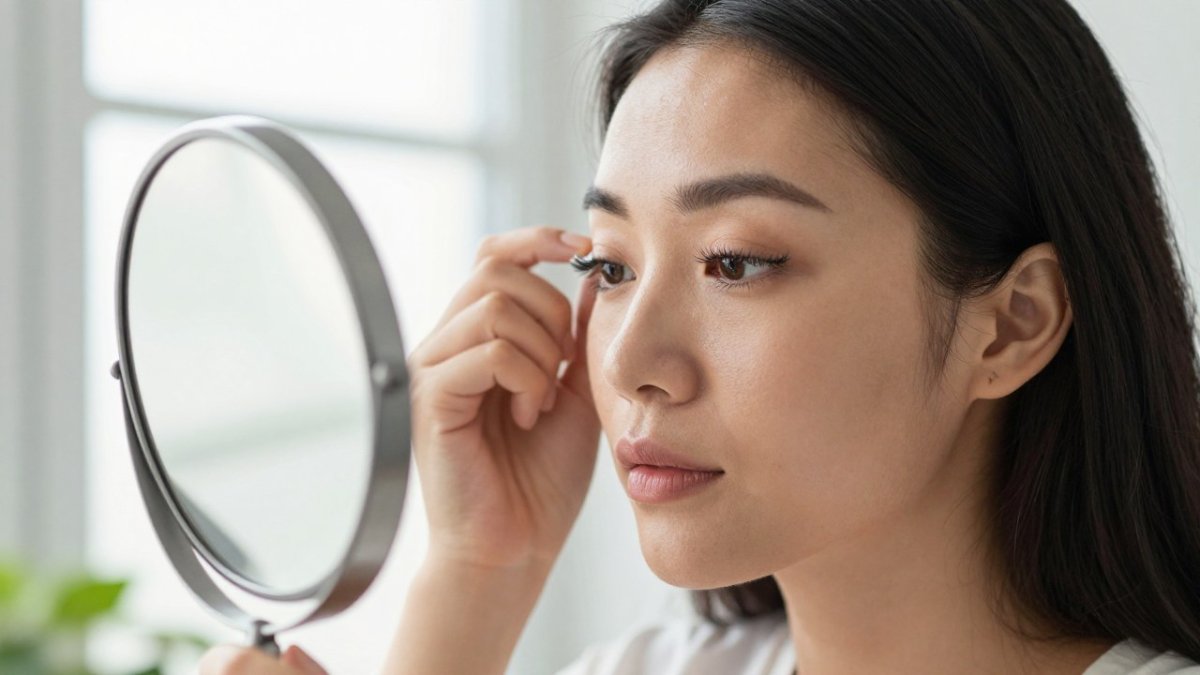
You can verify most of a set’s quality yourself with a magnifying mirror and good light. Run through this list the evening of your appointment, while the bond is still fresh and easy to see.
- Each extension moves independently when you brush gently
- No extension touches the eyelid skin
- No visible glue beads or white crust at the base
- Lashes point in the same direction as your natural growth
- Both eyes look symmetrical in length and curl
- No pulling or stinging when you blink
- The set feels light, not heavy
- No redness or swelling along the lash line
- Density looks natural for your eye shape
- You can close your eyes fully without the extensions catching
Eyelash Extension Aftercare That Protects Your Set
Aftercare decides whether a good application stays good. Keep the set dry for the first 24 hours while the adhesive fully cures. After that, cleanse the lash line daily with a lash-safe foam cleanser and a soft brush, because oil and makeup buildup weaken the bond and irritate the lid. Skip oil-based products near the eyes, avoid waterproof mascara, and never pick or pull at a loose extension. Brush gently with a clean spoolie, sleep on your back or on a silk pillowcase, and book your fill before you notice gaps. For a full daily routine, follow our daily care routine for eyelash extensions.
Safety Red Flags and When to Seek Medical Care
Most discomfort after a lash appointment is routine and settles within a day. The skill is telling that apart from a reaction or an injury that needs a clinician rather than another appointment with your lash artist. The American Academy of Ophthalmology notes that eyelash extensions and their adhesives are not currently regulated by the U.S. Food and Drug Administration, which places the burden of safety on the practitioner and the consumer, as documented in AAO guidance on eyelash extension safety. That makes your own observation the first line of defense.
Routine and expected. Mild tenderness at the lash line for a few hours after application is common, especially after a full set. A slight itchiness that fades within a day, or a small amount of redness right at the lash line that resolves overnight, is usually mechanical irritation from the application process rather than an allergy. These do not require medical care, but they are worth mentioning at your next fill so the artist can adjust placement or adhesive volume.
Contact your lash artist first. If a single extension is pulling, stinging, or visibly bonded to the skin, the fix is usually a correction rather than a medical visit. A careful technician will isolate and remove the offending extension. Persistent discomfort past the first day, a localized area of redness that does not fade, or a set that feels heavier on one eye than the other are reasons to call the artist before your next scheduled fill.
Seek medical care. The following signs mean stop and contact a clinician, not your lash artist:
- Redness, swelling, itching, or burning that starts within 24 hours and worsens rather than fades, which may signal an allergic reaction to the adhesive.
- Persistent pain, discharge, or a sensation that something is in your eye.
- Blurred vision, light sensitivity, or a change in vision after application.
- A visible sore, crust, or open area along the eyelid margin.
- Swelling that closes the eye or spreads beyond the lash line.
Why the distinction matters. An allergic reaction to cyanoacrylate adhesive, the common base for lash glue, tends to appear within the first day or two and often involves itching and swelling rather than pain alone. Mechanical irritation from a poorly placed extension tends to be localized and improves once the extension is corrected. An eye injury, such as a scratch to the cornea from a tweezers tip or a wayward extension, produces pain, tearing, and light sensitivity and needs prompt evaluation. Treating an allergic reaction as a placement problem, or a corneal scratch as an allergy, delays the right care.
Before your first set. Ask about patch testing, especially if you have sensitive skin, a history of adhesive reactions, or known allergies to acrylates. A patch test typically involves placing a small amount of adhesive behind the ear or on the inner forearm and watching for a reaction over 24 to 48 hours. It is not a guarantee, but it is a reasonable precaution. Tell your artist about any eye conditions, recent eye surgery, or contact lens use before the appointment.
Watch out: do not try to remove a problematic extension yourself with tweezers or oil; a home removal can pull a natural lash or scratch the eye, and a professional removal is faster and safer.
How to Evaluate a Lash Artist Before You Book
Skill shows up before the first extension is placed. A licensed lash artist should walk you through consultation, patch testing, and aftercare without being asked. Look for a clean workspace, sealed and dated adhesive, isolated workstations, and fresh tweezers. Ask how they map a set to your eye shape and natural lash strength; volume lashes have seen a 25% increase in demand over the past year, according to an American Beauty Association survey on trending lash styles, but volume is not right for every natural lash. Check their portfolio for close-up work: clean isolation, even direction, no clumps. You can review our own gallery of lash work to see what a well-applied set looks like up close.
Book Your Lash Consultation at Missouri Nails & Lashes
A consultation removes the guesswork. At Missouri Nails & Lashes, we are dedicated to beauty and bliss and deliver a rejuvenating experience in a stylish, cozy atmosphere. Browse our lash and nail services to see what fits your schedule, or contact us to ask a question or set up your first visit.
Your lashes should feel like nothing and look like you, only more polished. If you have been burned by a rushed set before, start with a consultation and let us show you what careful isolation and proper adhesive control actually deliver. Get started with Missouri Nails & Lashes and book a lash consultation in a clean, serene setting with artists who explain every step.
Frequently Asked Questions
What are the signs that eyelash extensions are bad?
Bad lash extensions usually show clumping, where multiple natural lashes are bonded to one extension, plus redness, itching, or a pulling sensation at the root. You may also see uneven lash direction, excess adhesive at the base, and premature shedding within the first week. These signs deserve attention rather than a wait-and-see approach.
Should eyelash extensions hurt or feel uncomfortable?
A correctly applied set should feel weightless. If your eyelash extensions hurt at the root, that is a signal the extension is too heavy, too close to the skin, or bonded to more than one natural lash. Mild sensitivity for the first day can happen, but sharp pain, burning, or a constant pulling sensation is not normal. Ask your lash artist to check the isolation and adhesive placement before the irritation worsens.
How long should high-quality eyelash extensions last?
Most clients need a fill every two to three weeks because natural lashes shed on a growth cycle. High quality eyelash extensions should retain most of the set through the first two weeks, with gradual, even shedding rather than patches falling out in a few days. Retention depends on isolation, adhesive, your lash growth cycle, and eyelash extension aftercare such as avoiding oil-based products around the eyes and cleansing gently.
How can you tell if eyelash extensions are applied correctly?
Check isolation first: each extension should sit on one natural lash, never bridging several together. The base should look clean without visible adhesive bumps, and the lash line should be neat with consistent direction, spacing, and symmetry. A patch test before your first full set helps confirm you will not react to the adhesive, and a licensed lash artist should walk you through aftercare before you leave the chair.
What makes a good eyelash extension technician?
A good lash technician holds a current license, practices strict sanitation, and uses a patch test for new clients. Look for a portfolio with close-up photos showing clean isolation, natural appearance, and consistent lash mapping across clients. Ask how they choose extension length, thickness, and curl type for your natural lashes, and confirm they explain eyelash extension aftercare and fill intervals.
Do lash extensions make you look younger or older?
The result depends on the style, not the extensions themselves. A customized lash map with soft lengths and a natural curl type opens the eye area and reads as a fresher look. Heavy, uniform sets with thick diameters can weigh the lid down and look dated. Lighter volume and hybrid styles tend to flatter most eye shapes.